
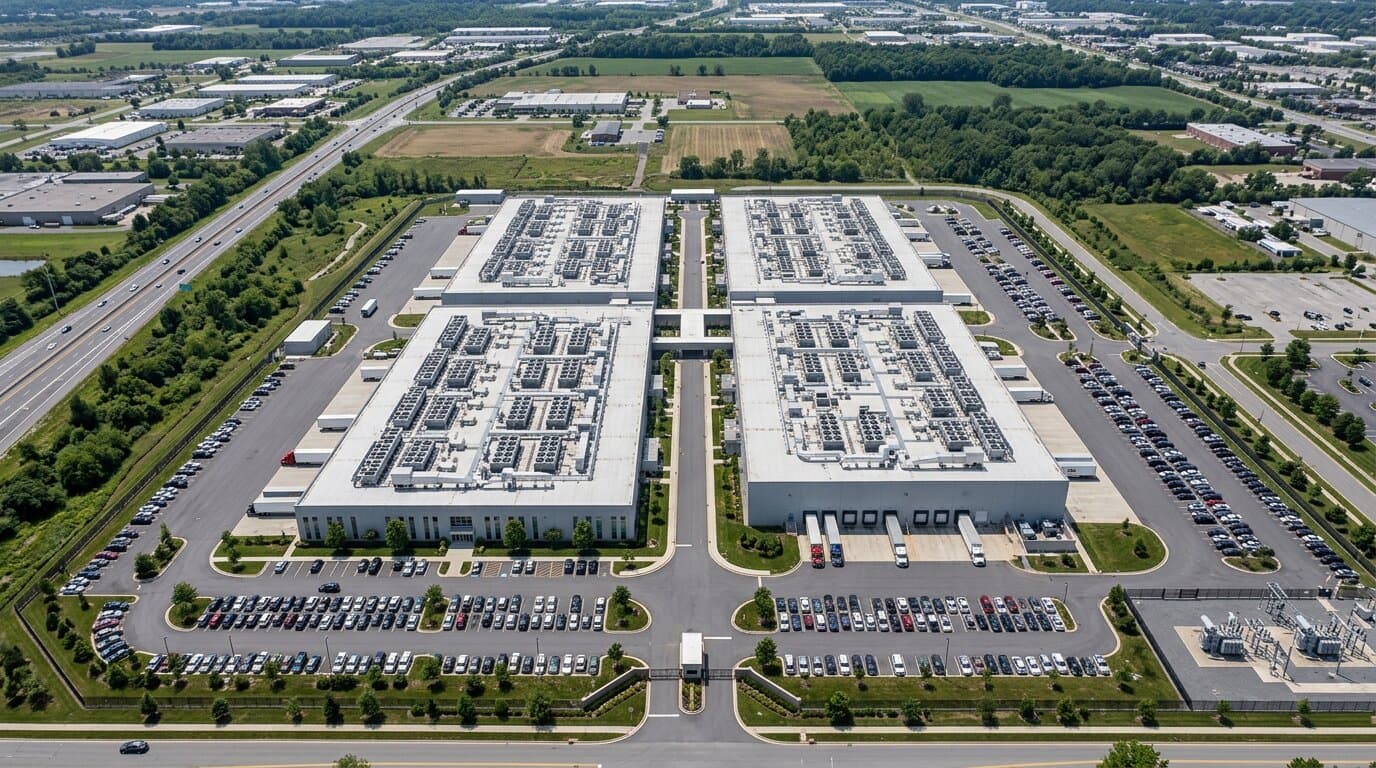
Colt Technologies: London 8 Data Center
About London 8 Data Center
The Colt London 8 Data Centre ("London 8") is part of the Colt Data Centre Services (Colt DCS) planned expansion at its Hayes campus, located in West London. As a future state-of-the-art facility, it will complement existing and planned facilities—namely London 4, 5, 6, and 7. Construction for London 6, 7, and 8 is expected to begin in 2026, with the first phase scheduled for delivery in 2028. Strategically, the site benefits from West London's growing status as a digital infrastructure hub, offering proximity to the city and strong connectivity potential to support hyperscale, enterprise, and AI workloads.
⚙️ Facility Highlights
- IT Power Capacity: London 8 will deliver up to 23 MW of IT power, supporting significant compute demand
- Data Hall Layout: Planned to include 4 × 1,000 m² halls and 4 × 680 m² halls, enabling flexible deployment and scaling of footprint
- Power Density: Will support an average design power density of 3–4.5 kW/m², aligning with high-density modern IT infrastructure requirements
- Design Efficiency (PUE): Targeted annualized design PUE is 1.35, reflecting efficiency-focused engineering for cooling and power systems
🔐 Security & Compliance
- No confirmed details
🌐 Connectivity & Carrier Access
- While detailed connectivity specifics for London 8 are not yet publicly available, Colt DCS facilities are universally carrier-neutral, providing access to a diverse range of national and international carriers, cloud platforms (e.g. AWS, Azure), and interconnection services. Given this, London 8 is expected to follow the same model, enabling robust and flexible network options.
💼 Who It Serves
Though no user case details are published specifically for London 8, the Colt Hayes campus expansion—including London 8—is clearly aimed at serving:
- Hyperscale cloud providers, looking for large-scale, high-power capacity facilities;
- Enterprise organizations with critical compute and colocation needs;
- AI and high-density workloads, given the power density and efficiency design;
- Multi-cloud and network-intensive users, who benefit from carrier-neutral infrastructure and interconnection flexibility.